
Taco trucks have become a delicious staple in communities and a favorite for events, parties, and casual lunches. From the sizzling sounds of a grill to the vibrant colors of fresh toppings, these mobile eateries bring the flavors of Mexican cuisine right to your doorstep! Understanding how much taco trucks cost to rent is a vital part of planning your next culinary adventure—whether you’re a taco enthusiast, an office worker seeking lunch options, an event planner looking to tantalize guests, or a corporate HR team wanting to spice up a meeting. Dive into this comprehensive guide, where we’ll explore everything from rental costs and local pricing variations to total operational expenses and tips on negotiating the best deal. Each chapter will equip you with the knowledge needed to navigate the world of taco truck rentals and elevate your next gastronomic experience!
What It Really Costs to Rent a Taco Truck: Navigating Hidden Fees, Equipment Demands, and Real-World Budgets
Renting a taco truck isn’t simply about paying a daily fee and rolling to the next event. It is a compact business investment wrapped in a mobile kitchen, and the numbers you actually see on a quote are shaped by more than the engine size. The concept sounds straightforward: you need a truck with a functioning kitchen, a plan for a few hours or days, and the crowd will come. In practice, the price you pay reflects a bundle of decisions about what kind of kitchen you want, how long you need it, where you operate, and what services are bundled into the rental package. The goal of thinking through these details before you sign is to avoid surprises when the invoice lands, and to ensure that the money you spend translates into reliable service, tasty tacos, and a legitimate business operation.
The most fundamental cost factor is the vehicle itself, but in the taco truck market the vehicle is not merely a mode of transport; it is a fully equipped kitchen on wheels. The truck typically includes a cooking line, refrigeration, a ventilation system, fire suppression, handwashing stations, and sometimes a small prep area. The extent and quality of this equipment will push the price up versus renting a plain delivery van or a standard pickup with a pretend “kitchen” set-up. You will also see variations in the base platform: a compact mobile kitchen on a trailer, a fully self-contained truck, or a modular unit that can be reconfigured for different menus. Each configuration brings different maintenance costs, power needs, and compliance considerations, which in turn influence the rental price.
Beyond the shell of the kitchen, the duration of your rental matters a lot. A single-day booking is priced differently from a multi-day event or a weekly arrangement. Short-term rentals often come with higher per-day rates because the provider is mustering a crew, preparing the equipment, and reserving the unit for a tight window. Long-term leases can be more economical on a per-day basis, but they bind you to conditions that may be harder to alter if your business plan changes. The math behind these rates is straightforward in concept: more days, more wear, and more time for the vendor to offset risk and logistics. If your event spans a weekend or includes setup and teardown, you might be looking at a package that covers the entire window, rather than a strict 8 a.m. to 5 p.m. period. In every case, the rental quote should spell out what “days” or “hours” really means and how overtime is charged.
Location is another pivotal driver. Urban centers with dense demand and higher living costs tend to push prices upward. A rental in a big city or a high-traffic festival corridor will likely come with premium pricing, not just for the space the truck occupies but for the complexity of logistics, permitting, and insurance required to operate in a busy area. Conversely, rural or smaller-market locations can yield lower baseline rates, though you may incur higher travel and freight charges if the truck must be moved long distances to your event. The geographical factor compounds with the season. Peak seasons for street food often see leaner availability and greater competition for units, nudging daily rates a little higher. When you shop, ask specifically about travel fees, delivery, and return logistics; these add-ons can dramatically alter the sticker price.
A fourth set of cost considerations centers on what the rental includes beyond the chassis and burners. Some operators offer packages that include staffing for an event, basic branding wraps, and turnkey maintenance. Others sell only the vehicle and the key appliances, leaving you to arrange a health permit, insurance, gas, water, and a cleaning service separately. Insurance requirements can be strict: a general liability policy is often non-negotiable, and some venues will demand additional coverage for the vehicle and for the staff. Permitting is not a trivial add-on either. Health department permits, fire safety compliance, and vehicle inspections are part of the operational fabric for any mobile food operation. Depending on the provider, permits can be bundled or billed separately, and some locations require site-specific approvals that add time and cost to your prep.
Branding, design, and equipment upgrades also shape the bottom line. If you plan to roll with a bold color wrap, a menu board that travels with you, or extra refrigeration to hold perishables for longer service windows, those features either come as part of a premium package or are added as a line item in the contract. This is a case where the cost of the truck is really the cost of a turnkey platform: you are buying a pre-fabricated, market-ready kitchen that can go from one event to the next with minimal downtime. Any customization, from specialized fryers to extra shelving to ergonomic layouts for the cooking line, tends to push the daily or weekly rate higher. Think about what your menu requires in terms of space, energy supply, and water usage. The more ambitious the kitchen, the more you should expect to pay up front for the rental, and sometimes for ongoing support.
For many people, a practical way to gauge rough pricing is to use benchmark references for related commercial vehicle rentals. In markets where a basic pickup or cargo van rents for roughly seventy to ninety dollars per day, a taco-truck rental will seat higher on the ladder. The exact delta depends on the stove stack, the refrigeration chain, and the ventilation system, but the logic is clear: the unit is not a blank canvas; it is a working kitchen that must meet food-safety standards. When you see a daily rate in the hundreds, remember that part of that premium pays for kitchen-grade appliances, power solutions, and a support framework that helps you stay compliant and worry-free during a busy shift. For longer engagements, vendors may offer weekly or monthly rates that resemble a business lease more than a simple rental. The comparison is not apples-to-apples, but it helps set expectations: you are buying more than time; you are acquiring a platform designed to produce safe, tasty food at scale.
If you want to understand how such pricing plays out in real life, consider the package structure a rental provider might offer. A basic option might include the vehicle and the essential cooking equipment, with optional add-ons for staff, fuel, and insurance. A more extensive package could provide turn-key service: operational support for events, on-site fuel provisioning, maintenance checks, and even a contingency backup unit in case of a breakdown. The value here is not simply convenience; it is risk management. Food service at scale involves compliance with health codes, fire-safety rules, and vehicle inspections. An inclusive package can reduce the administrative load and help ensure that your event runs smoothly, especially if you lack prior experience managing a mobile kitchen. When mapping out your budget, convert all these line items into a monthly or weekly cost if you plan to operate a business. That helps you compare rental quotes against the expected revenue and the time you expect to devote to the operation.
A useful way to learn more about the practical shape of a taco truck operation is to study the models that industry veterans favor for versatility and reliability. For readers curious about the options available, a concise overview of common configurations highlights how a truck’s build influences performance and, in turn, price. If you want to explore what models tend to show up in successful taco operations, see this overview of top taco truck models. This kind of reference can help you prepare a realistic specification to send to vendors when you request quotes, so you are comparing apples to apples rather than guessing what you’ll get for the price. top taco truck models.
Beyond these questions, your pricing dialogue should include careful attention to cancellation policies, contingency plans for equipment failure, and the logistics of load-in and load-out. Some events require early morning setups or late-night teardown, and not all rental packages are equally forgiving about time overruns or overtime labor. If the plan is to operate a storefront-style schedule from a fixed location, the economics shift again. You might prefer a longer-term lease that guarantees access to the truck on a predictable cadence, enabling you to budget more precisely. In such cases, negotiate terms that align with your revenue projections and the seasonality of your business. If your projected events cluster around a few high-volume weekends, a short-term, event-focused contract could be the right fit, with the understanding that the per-day rate will be higher than a full-month lease.
No single price tags the entire spectrum of taco-truck rentals, and there is no universal catalog price you can memorize before you begin outreach. The practical approach is to treat rental pricing as a function of the total package—vehicle vintage and condition, kitchen lineup, energy and water supply, staff if included, insurance coverage, permits, branding, and service level. Gather several quotes, request itemized breakdowns, and compare the total cost of ownership over the duration you need. Don’t shy away from asking clarifying questions about what happens if the unit is unavailable due to maintenance or if a port-of-call requires a different fire-suppression setup. The aim is to graduate from surface-level daily rates into a clear understanding of what you can reasonably expect to spend and what the vendor will deliver in return for that spend.
To close the loop on pricing reality, remember that rentable cooking platforms exist within a broader ecosystem of mobile food operations. The numbers you obtain are not just a function of time but a reflection of safety, service readiness, and the capacity to serve guests consistently. If you’re starting a new venture, or if you’re planning a large event, treat rental costs as a stepping stone, not a single ticket price. Plan for permits, insurance, branding, and potential staffing; plan for fuel and maintenance; and build a buffer for the inevitable surprises that come with operating in real-world conditions. When you assemble your vendor shortlist, keep a clear eye on the total cost of ownership rather than chasing the lowest daily rate. The right rental arrangement can provide a reliable platform that turns a culinary idea into a crowd-pleasing experience while staying financially sustainable.
Energy, sanitation, and ongoing support also shape the true outlay. Many taco-truck kitchens rely on a combination of propane and electricity; some units come with built-in generators, others require you to provide a source on-site. Generators add noise and maintenance; fuel budgeting should be included, along with routine service to prevent breakdowns during service hours. Sanitation is another non-negotiable line item: water supply and wastewater management must meet local health codes, and some packages bundle these logistics; others require you to coordinate with a licensed hauler or venue for waste disposal. These operational realities translate into measurable line items on your quote. The same attention applies to staffing, if you opt for event-ready crews; labor costs here can transform a seemingly modest daily rate into a substantial weekly operational expense.
Insurance and licensing add layers of protection and risk management. A typical mobile-food operation will need general liability coverage, vehicle liability, and possibly workers’ compensation if staff are involved. Some venues insist on proof of insurance before the truck arrives, and others require additional endorsements for equipment and product liability. The licensing timeline matters, too, especially if you are launching a business; clearance can take weeks, so weave permit processing into your planning horizon to avoid delays that push back your first event.
Budgeting roughly, a practical framework emerges. Start with a baseline rental rate per day, then add equipment add-ons, staff, fuel, and maintenance. Add permits and insurance as non-negotiables. Include branding and any customization as a separate line item. Finally, factor in a contingency reserve of around 10–20 percent to cover unexpected repairs, scheduling changes, or last-minute logistic shifts. In a hypothetical package where the base rent is moderate, a conservative add-on estimate for staff, fuel, and insurance might push the daily all-in cost into a few hundred dollars, with higher figures for longer events or more elaborate kitchens. This kind of budgeting—an itemized forecast with a built-in cushion—helps you compare quotes with transparency and reduces the chance of sticker shock when you sign a contract.
If you want to dig deeper into industry context, consult general small-business guidance on how to structure costs for a mobile food operation, including permits and funding considerations, to complement the rental-specific math. External resources offer additional clarity for those mapping a path from idea to operation, especially for first-time operators who must balance ambition with compliance. For practical guidance on starting a mobile food operation and navigating permits, the Small Business Administration offers guidelines and checklists that help frame the overall costs and responsibilities of running a food-truck business. And for readers who want to compare options across providers, external industry resources offer exchange-like platforms for quotes and terms from multiple vendors.
External resource:
https://www.tacotruckrentalnetwork.com
From City Blocks to Country Roads: How Local Variations Shape Taco Truck Rentals
Taco truck rentals unfold as a study in local context as much as they do in appetite. The number of vehicles a new operator contemplates is rarely dictated by a universal price tag. It is shaped by where the truck will move, who will buy the food, and how the regulatory landscape compresses or expands opportunity. The short answer—how much to rent—depends on the place, but the longer story reveals a layered economics that transcends any one-day rate and speaks to the business’s longer arc. In cities with dense populations and a lively street-food tradition, the market supports a bustling ecosystem of mobile kitchens. In a place like a metropolitan center, the practical reality is not about stacking more trucks on the curb; it is about orchestrating a fleet that can serve multiple neighborhoods, chase events, and adapt to shifting foot traffic. A high concentration of residents, workers, and visitors creates a natural demand density that can make a multi-truck strategy viable. Yet density brings competition—the same streets can host a dozen vendors who offer similar bites during peak hours. In such environments, the decision to rent more than one truck rests on a clear plan to differentiate the menu, secure favorable street-permit placements, and maintain a tight schedule that keeps queues short and customers coming back for more. When the core question centers on price, many first-time operators assume that a daily rental rate is the only cost. In practice, this rate acts as a doorway to a much broader financial system, one that includes how the truck is equipped, how it is powered, and how it is integrated into the local food policy ecosystem. A truck’s chassis is only the starting point. Transforming a shell into a fully functional street kitchen means adding kitchen-grade equipment, fire suppression, safe waste disposal, reliable electricity, and a layout that supports fast, safe, and sanitary service. Each modification carries its own price tag and schedule implications. The decision to rent, then, becomes a question of the alignment between the rent contract, the costs of necessary modifications, and the revenue potential generated by the intended route. In urban settings, where demand clusters around business districts, nightlife corridors, and weekend events, a few practical truths emerge. First, the street-food calendar is relentless. There are lunch-hour surges, after-work windows, and seasonal festivals that can fill a calendar with opportunities if you can secure the right spots and the legal permissions to operate there. Second, the cooking footprint matters. A compact, well-planned kitchen reduces operating time between shifts and lowers labor costs, which in turn supports more reliable margins even if the per-day rental rate is higher than in another market. Third, speed and consistency win. The ability to produce a steady stream of hot, fresh tacos without compromising safety or quality makes the difference between a busy corner and a quiet one. In rural or mountainous regions, the arithmetic changes. The same market that feels almost saturated in a city can feel expansive and delicate outside the urban core. A single truck might be enough to serve weekly farmers’ markets, craft fairs, school events, and rotating placements in small towns. In these areas, demand tends to be episodic rather than constant. The truck becomes a mobility asset that moves toward peak hours and events rather than staying in one fixed place. The economic calculus here prioritizes reliability over scale. Costs still accumulate—vehicle maintenance, fuel, insurance, permits, and ongoing evaluations of where and when the truck can legally operate—but the revenue engine is driven by dependable scheduling and a strong local following rather than by high-density foot traffic alone. In practice, this means that a rural operator may pay less in daily rent but must absorb a higher share of travel time, set-up time, and temperature-control planning, all of which eat into the overall margin if the operation is not tightly managed. These dynamics—urban density versus rural dispersion—shape how many trucks an entrepreneur should own or rent in a given locale. The urban model often rewards a small, agile fleet that can switch between neighborhoods, campuses, and event venues with a consistent level of service. The rural model rewards a carefully chosen single or dual-unit approach, where logistics and community calendars drive utilization rather than the sheer number of vehicles parked on the street. The practical takeaway is straightforward but powerful: the optimal fleet size is a function of the local demand curve, regulatory environment, and the entrepreneur’s operational discipline rather than a single price point. The landlord of the street, in this sense, is the local market itself. It dictates when and where trucks can operate, how long they can stay in a given spot, and what upgrades the kitchen requires to stay compliant and competitive. A robust plan for any area begins with a precise demand map: which neighborhoods draw consistent crowds, which events recur with predictable cadence, and how long customers are willing to wait for fresh tacos. From there, the operator translates demand into a schedule, a route, and a maintenance routine that keeps a fleet reliable. This is where the cost structure reveals its true shape. The headline rent you might sign for a truck is only the starting frame. Beyond that, the vehicle must be outfitted to meet health and safety standards; the kitchen equipment needs to be installed and tested; and the operation must be insured, licensed, and integrated with a permitting regime that varies by city or county. The scale of these overheads matters because it informs how many events must be captured to break even on a given truck. In an urban cluster, high volume can support several trucks if each has a distinct strategic location and a complementary menu. In a rural setting, the same number of trucks might yield fewer events but greater per-event profitability if operating costs are tightly controlled and travel between events is minimized. With those realities in mind, many operators find it useful to think of rental as a phased investment rather than a one-off expense. Start with one truck, prove the concept on a few reliable routes, and monitor the balance between permit costs, labor, and food costs. If the math fits, expand to a second truck to broaden coverage or to run two shifts on peak days. Only after the first two stages prove sustainable should a third truck be considered. The discipline of testing, learning, and scaling is the backbone of a durable mobile-food venture. To ground the practical choices in equipment and layout, consider reviewing top taco truck models for culinary success as a reference for how equipment choices influence costs, capacity, and reliability. This is not a plug-and-play decision. It is a design exercise in which the choice of kitchen layout, generator capacity, cold storage, and safety features affects service speed, portion control, and waste management. In addition, the broader ecosystem matters. Permits, inspections, and health compliance tune the operating rhythm, while insurance and maintenance tune the financial rhythm. The cost of fuel or propane, the price of ingredients, and the wage bill for staff all press on cash flow. The effect of these variables is felt in every city and every town, and thus the final equation for how many trucks to rent changes from place to place. In a city where permit windows are long, penalties for late compliance are low, and there is a steady festival stream, a multi-truck operation might be attractive early in the growth phase. In a small town with strict parking rules and limited event calendars, a single, well-located truck can dominate the market for months, building loyalty before a broader expansion is attempted. This nuanced interplay between local demand, regulatory realities, and operational discipline should guide every decision about fleet size. The overarching lesson is that local variations do more than shift the number of trucks you rent. They redefine which costs matter most, how to price the menu to cover them, and which operational rhythms will keep the business resilient. The best operators blend a keen sense of geography with a disciplined financial plan, treating the rental decision as a stepping-stone to a durable, community-rooted street-food venture rather than a short-term retail experiment. As markets evolve—seasonally in some places, with regulatory shifts in others—the fleet strategy should evolve as well. The question of how many taco trucks to rent cannot be answered in a vacuum. It requires an intimate reading of the local street-scene, a candid assessment of the capital available for modifications and compliance, and a clear sense of the cadence of demand across neighborhoods and events. By aligning fleet size with these local tempos, operators can craft a sustainable path that honors both the social joy of taco culture and the practical realities of running a legitimate, well-managed mobile kitchen. For readers seeking a broader urban context that connects street-food culture to policy and economics, a city-wide overview offers a helpful lens into how those dynamics play out in real life. External resource: https://www.austintexas.gov/news/austin-food-truck-scene-cultural-economic-overview
Beyond the Daily Rate: Mapping the Full Cost Landscape of Renting Taco Trucks
Renting a taco truck is more than settling on a price tag per day. The true math sits in a broader cost landscape that unfolds the moment a business contemplates mobile street food. A rental truck is not a mere vehicle; it is a compact kitchen on wheels that must perform reliably, meet health and safety standards, and travel between events with minimal downtime. The daily rate only hints at what a kitchen-on-wheels will cost over a project, season, or tour. In markets where food trucks have become a social and culinary fixture, operators learn quickly that flexibility matters as much as price. The decision to rent, rather than own or contract, hinges on how your specific operations will be scheduled, how far you intend to travel, and how much you must customize the truck to fit your menu, branding, and service style. The best way to approach the numbers is to picture every moving piece of the operation, from the vehicle’s mileage to the permits that keep you street-legal, and then to estimate how each factor aligns with your planned events and revenue targets. In this sense, the rental decision mirrors a broader business investment: the truck is a platform, but the profitability rests on how well the platform supports your kitchen, your team, and your customers.
For context, the base daily rental rate is only a single thread in the fabric. When we look at related mobile-vehicle rentals—such as pickup-style trucks used for a range of purposes—the reported daily costs vary by city and season. In Silver Spring, for example, pickup truck rentals have averaged roughly $52 to $61 per day as of December 2025. In a different locale, such as Ponce, the same category has hovered around $83 per day as of January 2026. These figures are not a one-to-one bracket for a taco-truck rental, but they illuminate how location, demand, and vehicle class influence daily price. A taco truck rental often carries additional layers: the cost of outfitting a kitchen, the need for specialized insurance, and the number of days you plan to operate. In practice, many operators negotiate longer rental terms, or choose packages that bundle basic outfitting with a service component, rather than a bare daily rate. The takeaway is clear: a seemingly modest daily price can mask a larger, multi-faceted cost envelope.
Beyond the posted daily fee, the six core cost drivers tend to define the true financial footprint. Vehicle maintenance sits at the top of this list. A mobile kitchen pushes a truck’s mechanical systems beyond ordinary wear. Expect routine maintenance—oil changes, brake checks, and tire wear—to occur more frequently than with a standard courier vehicle, especially when you are logging evenings and weekends and running heavy cooking equipment. The generator and electrical system also demand regular attention, from fuel supply to inverter checks, to ensure stable power for refrigeration, grills, and ventilation. Fuel costs follow next. When a truck must cover substantial ground between events or navigate congested urban routes, fuel can become a meaningful line item. The more you travel, the more price volatility you’ll feel, and planning often means building a cushion into your event schedule.
Insurance represents another critical line. A mobile-food operation requires coverage that protects vehicle liability, commercial auto exposure, and general liability related to food service. Premiums vary widely by driver history, coverage limits, and the scope of your operations—whether you’re performing at a fixed market, city festival, or traveling between counties. Permits and licenses form a similarly uneven terrain. Local jurisdictions regulate mobile vendors with local health permits, fire-safety clearances, and street-closure authorizations. Some regions emphasize annual renewals; others charge per event or per season. The cost here can swing from modest administrative fees to more substantial, recurring expenditures depending on the city and the scope of permitted service.
Staffing expenses, though not exclusive to the rental itself, color the ongoing economics of a taco-truck operation. If you hire cooks, expeditors, or drivers, wages, payroll taxes, and scheduling software contribute to the monthly burn. In many markets, seasonal staffing cycles align with festivals and harvest periods, which means costs rise and fall with demand. Food-supply costs complete the circle. Ingredient pricing, supplier contracts, and order volumes drive daily menus and the margins on every taco sold. Wastage, spoilage, and the need for reliable refrigeration all eat into a business’s bottom line, especially when you are balancing high-quality ingredients with last-minute event changes.
When you assemble a rental plan, you also encounter equipment setup costs that can dwarf the daily rental rate. The kitchen equipment—stovetops, grills, fryers, refrigeration units, hood systems, sinks, and grease containment—must be integrated with the vehicle’s architecture and electrical load. A basic, lean setup may fit into a few thousand dollars of one-time outfitting, whereas a more robust, full-service kitchen can push outfitting costs into the tens of thousands. The level of customization determines both the initial outlay and the frequency of maintenance. Some trucks arrive with a turnkey culinary platform, while others require significant modifications to accommodate your menu. The more you customize, the higher the potential total cost, but this can also translate into greater service efficiency and better product consistency for customers.
All of these variables—driven by location, duration, and the degree of customization—converge to shape the true renting cost. Your event calendar, travel radius, and menu complexity will guide the budgeting process. If you plan to operate across multiple venues in a metropolitan area, you should expect higher insurance levels, more frequent permits, and a more elaborate equipment plan than a single-pop-up arrangement. Conversely, a smaller, more contained schedule can keep ongoing costs steadier, even if the daily rental rate is comparatively higher in a particular city. The practical step is to map the numbers against your expected revenue from each event: what you charge per taco, how many servings you must sell to cover fixed costs, and how many events you can book to realize a sustainable profit.
For operators evaluating configurations, it helps to examine how different truck layouts influence both cost and service capability. A compact, efficient kitchen with essential appliances can minimize both outfitting and operating costs while delivering dependable performance. A larger, more diverse kitchen expands menu potential but increases start-up, maintenance, and insurance requirements. In this light, the right choice depends on your menu strategy and the cadence of your events. As you weigh options, a useful companion resource reviews various taco-truck configurations and models that best balance capacity with cost, illustrating how different layouts correspond to different price-tags and operational goals. For a focused look at how these configurations translate into business potential, see Top taco truck models for culinary success. (https://ordertacoselpelontacotruck.com/blog/taco-trucks-unleashed-top-5-models-for-culinary-success/)
Each operator will experience a distinct cost rhythm, but the common thread is clear: rental price is the gateway, not the destination. If you’re forming a plan, start with a conservative rental baseline based on your city’s average and then layer in the expected outfitting, permits, and staffing costs. Build in contingency for fuel price fluctuations and maintenance needs, then run through a scenario that projects revenue by event type, season, and distance traveled. This approach helps prevent misalignment between the thrill of a flexible, mobile kitchen and the disciplined discipline of a financially sustainable business model. It also makes clear how much you must invest in preparation versus what you can expect to earn from each service window.
External resource aside, the practical takeaway is that the economics of renting a taco truck demand a holistic view. The daily rate matters, but it is the sum of maintenance, fuel, insurance, permits, staffing, food-supply dynamics, and the cost of equipment setup that determines whether a rental makes financial sense for your culinary goals. If you chart these pieces carefully, you can identify a rental path that keeps your menu mobile without sinking your margins. And when you’re ready to compare configurations and models, a quick reference to the best-fit layouts can sharpen your decision. For broader context on vehicle rentals and related costs in various markets, you can consult a general vehicle rental resource at the following external reference: https://www.booking.com
Beyond the Daily Rate: A Deep Dive into Taco-Truck Rentals versus Ownership
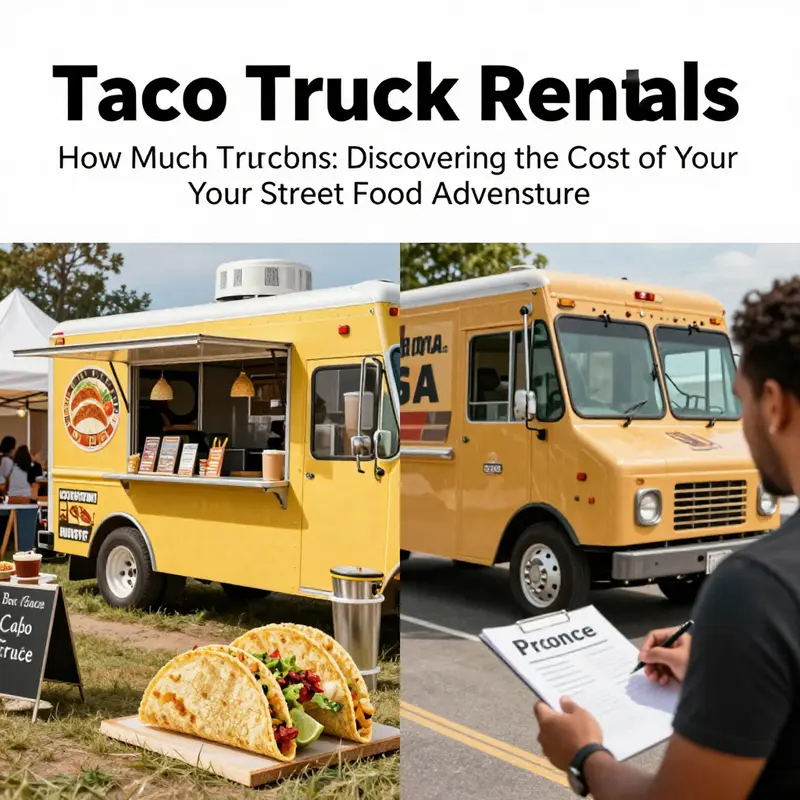
When a prospective street-food entrepreneur asks, how much are taco trucks to rent, the question sounds straightforward enough. Yet the answer is not a single figure but a matrix of costs that expands as soon as you shift from a one-off event to a steady, year-round operation. The research landscape confirms this gap: there isn’t a tidy, taco-truck-specific rental price publicly published. What does exist are baseline figures for similar mobile assets, such as pickup-truck rentals in various regions, which can illuminate the budgeting exercise even if they don’t map directly to a fully equipped taco truck. For instance, daily rates for compact or mid-size pickups hover in the low tens of dollars per day in some markets, rising into the mid- to upper-50s per day in other locales. These numbers, while not a substitute for a dedicated taco-truck rental quote, help frame the underlying economics of mobile business mobility. They point to a core truth: renting might seem affordable in the short term, but it does not capture the full spectrum of costs that come with presenting hot food on the go year after year.
If you’re pursuing a rental path for a taco operation, you will soon encounter a layered cost structure beyond the sticker price. What many rental services advertise, and what the business reality often requires, can diverge. A rental quote may cover chassis and some upfront equipment, but it frequently leaves regulatory fees, health and safety compliance, insurance, and ongoing maintenance on the buyer’s or lessee’s shoulders. In other words, a dollar figure per day can hide a tangle of permits, inspections, and service commitments that are essential to feeding the public. This is not a critique of renting; it’s a reminder that the true economic decision revolves around total cost of ownership over the expected lifetime of the operation, not merely the daily outlay.
To grasp the comparison more holistically, it helps to consider ownership as a complete life cycle: the initial outlay to procure and outfit a truck, followed by recurring operating costs, and finally the potential for revenue to outpace those costs. Ownership begins with the vehicle and kitchen equipment. A taco truck is not just a bus with a grill; it is a compact kitchen on wheels, typically built with fryers, griddles, refrigeration, a hand-wash station, a water system, and fire-suppression equipment. The purchase price for a used, well-equipped unit can vary widely depending on age, condition, and configuration, with new, purpose-built units often landing in a six-figure range. Even a conservative, lightly equipped pre-owned truck can require a substantial six-figure investment once you account for installation of compliant sanitation systems, gas lines, electrical capacity, and food-prep layouts tailored to your menu. The cost of modifications is not incidental. Plumbing and electrical upgrades, ventilation, stainless-steel interiors, and custom work to meet local health and safety standards can push the total well beyond the initial sticker price.
Beyond the capital outlay, the ongoing costs of ownership are a steady drumbeat. Fuel and maintenance are obvious. A taco truck in steady service can burn through fuel differently than a standard vehicle because it operates for longer hours in demanding environments, often without the reliable downtime of a traditional brick-and-mortar kitchen. Maintenance cycles for a commercial kitchen on wheels are more frequent and more critical, given the combination of heavy equipment, high ambient heat, and constant vibrations from road travel and city stops. Then there are licensing and permitting costs that vary by location but tend to be substantial enough to warrant a dedicated line item in a budget. Health department permits, business licenses, mobile vendor permits, and quarterly or annual inspections can require upfront fees and regular renewals. Insurance is another ongoing obligation, typically covering general liability, vehicle, and workers’ compensation if you hire staff. The numbers here are not one-size-fits-all; they are highly jurisdiction-specific and often scale with the truck’s size, engine power, and the scope of your operation.
Depreciation—an often overlooked financial reality—also plays a role in ownership decisions. A taco truck, like any specialized vehicle, loses value over time. The rate of depreciation depends on age, miles traveled, and the wear from consistent heavy usage in competitive markets. Yet depreciation is not merely a tax consideration; it influences financing terms, resale potential, and even the feasibility of using the asset as collateral for startup funding. A well-maintained unit can retain more value and offer smoother financing terms for a subsequent upgrade, which many operators consider as part of a long-run growth plan.
On the revenue side, tacos and street-food concepts can perform well in certain markets—food culture, festival calendars, and busy business districts contribute to a favorable demand environment. Revenue potential is, however, highly location-driven. A truck in a bustling urban core with regular event traffic may capture substantial sales, while the same truck in a less trafficked area or during off-peak seasons will face greater volatility. This is where the ROI calculus becomes essential. Short-term flexibility, a key virtue of renting, can be very appealing when you want to test menus, locations, or hours without committing capital. Yet the long-term economics of ownership can win out if you can consistently generate enough gross profit to cover debt service, maintenance, insurance, and the inevitable regulatory expenses—and still leave a margin for labor, marketing, and reinvestment.
To illustrate these ideas in practical terms, imagine a hypothetical operator who plans to run 3 to 4 days per week, serving lunch and dinner at a mix of events, farmers’ markets, and busy intersections. If a taco-truck rental option existed with transparent all-in pricing, it would ideally include the vehicle, standard kitchen equipment, and a predictable monthly fee. In the absence of a clean, standardized rental package, you can use a proxy based on comparable mobile assets. If a smaller pickup-style vehicle used for a similar mobile business carries a baseline of about $52 per day in Silver Spring, or $67 per day in Palmdale, a 20- to 25-day month could translate to approximately $1,000 to $1,700 in base rental costs, excluding events, insurance, and regulated fees. Scale that to the demanding calendar of a taco entrepreneur who intends to work weekends and evenings, and you quickly reach a monthly figure that rivals a modest mortgage payment, if not more, when all required additions are folded in.
On the ownership side, consider a more holistic snapshot. A fully equipped taco truck might demand a six-figure upfront investment. If you finance this purchase over five years at a modest rate, the monthly payment alone can run into the low thousands, depending on loan terms and down payment. Add roughly a few hundred dollars each month for fuel and general maintenance, several thousand dollars per year for permits and inspections, and a similar spread for insurance. When you also include staffing costs for peak hours, plus an annual marketing push, the monthly outlay remains significant. Yet, if your revenues stay consistently above the break-even line and you accumulate a stable customer base, ownership offers the prospect of long-term cost containment and asset accumulation—especially as the asset’s value remains usable and potentially salable.
The decision, then, hinges on your business model, risk tolerance, and appetite for capital expenditure. Renting can provide a low-commitment way to enter the market, test menus, and refine service areas with far less capital at risk. It supports agility, enabling you to respond to shifting tastes or seasonal demand without being tied to an owned asset’s depreciation schedule. Owning, by contrast, concentrates risk and reward in a single asset but can yield meaningful benefits over time for operators who achieve high utilization, consistent locations, and a scalable growth trajectory. If you’re still in the exploratory phase, you might begin with a rental approach to build data—customer turnout, peak hours, vendor competition, and optimal routes—while concurrently mapping a longer-term plan that could justify the shift to ownership or at least to a hybrid model that combines a lean ownership backbone with flexible rental capacity for peak periods or special events.
For readers who want to explore practical configurations and a sense of the current market for food-truck operations, a useful reference is the collection of planning resources that outline varied models and entrepreneurial paths. See Top Food Truck Models for Entrepreneurs for a concise overview of how different configurations can align with bold plans and modest budgets. This resource can help you picture the kinds of equipment layouts, power strategies, and workflow optimizations that influence both rental suitability and ownership viability. A quick step in your due diligence is to translate these configurations into a cost map that reflects your local regulatory climate, monthly revenue expectations, and the cadence of your planned events. In parallel, consult reputable sources for initial guidance on licensing and startup considerations, such as the U.S. Small Business Administration, which offers broad, practical directions on licensing, permits, permits and financing options, and business planning that can anchor your budgeting exercise in reality.
Ultimately, the path you choose should reflect not only a comparison of daily or monthly price tags but an integration of your menu concept, target customer base, and strategic goals. Renting may be the prudent, low-risk entry point when you need to test demand quickly, minimize upfront risk, and keep options open for scaling. Owning may be the prudent, asset-building choice when you have a clear growth trajectory, a reliable demand corridor, and the cash flow to service debt while maintaining a margin for labor and reinvestment. Either way, your decision should be anchored in a disciplined financial plan that accounts for the full spectrum of costs and the real-world variability of revenue. For operators looking to link strategy with concrete data, the harmony between practical budgeting and ambitious growth is the true compass guiding whether the taco truck sits on the curb as a rental partner or travels the road as an owned, kitchen-on-wheels business.
External resources can further support the budgeting process and regulatory awareness. For broader startup guidance and regulatory considerations, refer to official small-business resources at https://www.sba.gov.
Beyond the Sticker Price: Navigating the Real Cost of Renting a Taco Truck
Renting a taco truck is a practical entry point for cooks testing a street-food concept or expanding to mobile events. It is appealing because it lowers a barrier that can stop a new business before it begins: the upfront investment in a fully equipped kitchen-on-wheels. Yet the decision to rent is not simply about a daily rate. It is a bundle of costs and regulations that together determine whether a particular event, season, or location will be financially viable. The research landscape mirrors this reality: there is little published data on standardized rental fees for taco trucks. What exists tends to come from broader vehicle-leasing markets or from industry anecdotes, not a fixed, nationwide price. That ambiguity itself matters because it pushes prospective operators toward a more methodical budgeting approach. In practice, rental costs are anchored by several interlocking factors: the base rental rate, the condition and outfitting of the vehicle, the terms of the rental agreement, and the broader regulatory and compliance costs that make the operation legal and sustainable over time. The cultural context helps to illuminate why some people choose rental rather than ownership. In places with vibrant street-food ecosystems, like certain Southwestern and Western locales, the flexibility to scale up or down for events can be worth more than a fixed monthly payment. The Austin example from the broader research hints at a pattern: when permits and inspections are navigable and when the vehicle meets a given culinary standard, the hurdle to starting up becomes a matter of logistics rather than a mountain of capital. But that advantage can disappear if the legal or insurance costs surge, or if the rental company staggers into a tightening market. The bottom line is clear: the cost of renting a taco truck is not a single daily figure but a portfolio of expenses that must be anticipated and reconciled before any event date.
As a starting point, it is useful to separate what a renter typically pays from what a long-term operator or a first-time entrepreneur must prepare for. The core rental rate is only one component of the financial picture. Many operators discover that the daily or weekly fee is just the opening entrance fee to a broader payment structure that includes fuel, maintenance, and sometimes depreciation recaptured through the lease terms. In the absence of published standard rates, prospective renters should expect to encounter “all-in” packages that attempt to simplify budgeting, and separate arrangements where each line item is billed separately. The absence of a universal price is not a flaw; it is a reflection of a market that weights cost by location, truck specifications, the seasonality of demand, and the length of the rental commitment. In practice, the negotiation table becomes the most important tool. The way a rental is assembled—whether it is a self-contained, fully equipped kitchen-on-wheels or a stripped-down base vehicle with optional kitchen modules—will shape the final price and the flexibility of terms. It is not unusual for the same truck model to command different prices in neighboring markets simply because the regulatory climate and insurance requirements differ. For this reason, the most reliable method to gauge cost is to request formal quotes that itemize every cost line and to compare those quotes in an apples-to-apples format. This requires a clear understanding of what is included in the rental: Is the engine and chassis covered? Are the kitchen systems tested and insured? Is ice, water, or waste disposal part of the package, or are those responsibilities borne by the renter through separate providers? Understanding these details helps separate a seemingly low daily rate from a more expensive arrangement that quietly includes hidden costs.
To build a practical budgeting framework, imagine the rental decision as a sequence of decisions about scope and duration. First, define the event calendar and anticipated volume. A single weekend market appearance will carry a different cost calculus from a month-long festival circuit. Longer commitments often yield better per-day pricing, but they also bind the operator to a specific schedule and location. Second, assess the vehicle’s outfitting level. A basic mobile kitchen may satisfy some events but fail for others with high health-safety expectations or elaborate menu concepts. The more complex the equipment—griddles, fryers, refrigeration, ventilation—the higher the risk and, accordingly, the price. Third, consider the permit and compliance thresholds. Depending on the city or county, obtaining a valid health permit, fire-safety clearance, and a mobile-vendor license can be as costly as the rental itself in some jurisdictions. These costs are not optional extras; they are prerequisites to operating legally, and they often have annual renewal cycles that must be budgeted alongside the rental. Fourth, insurance is not a mere formality. Liability coverage for a mobile food operation protects against a broad set of incidents—from vehicle accidents to equipment failure that could lead to contaminated food scenarios. The premium will reflect the vehicle’s value, the equipment installed, and the typical operating environment. Fifth, ongoing operating costs cannot be ignored. Fuel, routine maintenance, propane or gas supply, water, waste disposal, and even routine cleaning costs accumulate over the life of a rental. Some operators stream these costs into a flat daily rate; others itemize them separately. When constructing a budget, it is crucial to estimate the total cost of ownership (TCO) for the rental period, not merely the sticker price on the door. A simple way to approach this is to multiply the anticipated number of event days by the all-in daily rate and then add estimated permit renewals, insurance premiums, and essential maintenance. If the all-in rate fluctuates with location or season, build a range rather than a single point estimate to avoid overcommitting financially when market conditions shift.
From a strategic perspective, rental decisions often hinge on the operator’s goals. If the aim is to test a concept with minimal upfront risk, renting can be a prudent choice, provided the budget accounts for the regulatory and operational contingencies described above. If the goal is to scale rapidly or to pursue a high-volume schedule, rental may eventually give way to partial ownership or long-term leasing that couples equipment upgrades with favorable terms. Even within the rental space, there is room for optimization through design choices and supplier partnerships. A truck that is easy to clean, engineered for quick setup and teardown, and adaptable to different menu configurations will reduce labor costs and downtime between events. This is not just a matter of convenience; it translates into more events met per week and potentially better margins per event. The decision-making process also benefits from looking at the broader ecosystem surrounding mobile food service. The U.S. Small Business Administration (SBA) offers guidelines on permits, financing, and operational considerations for food trucks, which can help shape a realistic expectation of the costs beyond the truck itself. While the SBA guidance is not a rental warranty, it provides a scaffold for understanding licensing, financing, and compliance that influences every rental decision. For readers who want a quick sense of how design choices influence cost and performance, consider exploring resources focused on the operational models that have proven successful for food-truck entrepreneurs. A practical way to engage with this material is to examine the concept of selecting equipment and configurations that maximize versatility, durability, and ease of cleaning. A chapter on the various models can illuminate how a given layout supports multiple menu items, reduces labor, and lowers risk, which in turn affects the rental price by reducing the need for additional equipment and staff.
For readers curious about how equipment design interacts with cost and culinary outcomes, a useful reference is the discussion of model variety and its impact on kitchen efficiency. This is where an entry-level operator might gain an edge by choosing a design that balances capability with maintenance needs. To explore a concrete example of how design choices translate into practical outcomes, you may want to examine the broader catalog of model options in the industry. A convenient starting point is a resource focused on the most popular food-truck configurations and how they map to different menu strategies. For those who want to dive deeper into the specifics of model selection and its financial implications, the article cluster that surveys top food truck models for entrepreneurs can be a helpful companion. It offers a perspective on how different layouts support menu variety, cooking speed, and resource management. This kind of knowledge helps a renter align the vehicle’s capabilities with business goals, ensuring that the chosen rental package supports both creative aspirations and financial discipline. To read more on this topic, you can explore the guide that analyzes various models and their practical implications for new operators, which provides a clear sense of how design choices influence cost, reliability, and the ability to generate revenue on the street. Top food truck models for entrepreneurs
In sum, the cost to rent a taco truck cannot be boiled down to a single daily figure. It lives in the interplay between the vehicle’s outfitting, the rental agreement structure, and the broader regulatory and operating ecosystem. Prospective renters should approach the process with a clear budget framework, a well-defined event calendar, and a demand-driven plan that anticipates permits, insurance, and maintenance. The most reliable path to a fair price is to solicit formal, itemized quotes from multiple providers, compare them against a well-thought-out budget, and adjust for the realities of local regulations and seasonal demand. This approach can turn a vague “how much” question into a precise, defendable estimate that aligns with the operator’s strategic goals and the realities of street-food commerce. For additional guidance on starting and financing a food-truck venture, consult authoritative resources like the Small Business Administration, which offers broad guidance on permits, funding, and regulatory considerations that bear directly on rental decisions. External resource: https://www.sba.gov/business-guide/plan-your-business/start-your-business
External resource: https://www.sba.gov/business-guide/plan-your-business/start-your-business
Final thoughts
Renting a taco truck doesn’t just add flavor to your event; it creates a vibrant atmosphere and unforgettable memories. By understanding the costs involved, you can turn any gathering into a fiesta, creating experiences that tantalize the taste buds and warm the heart. Remember, each chapter of this guide has equipped you with the tools to navigate not just the prices, but also the culinary creativity that taco trucks offer. Embrace the joy of delicious tacos and unforgettable gatherings—your next taco truck adventure awaits!

