
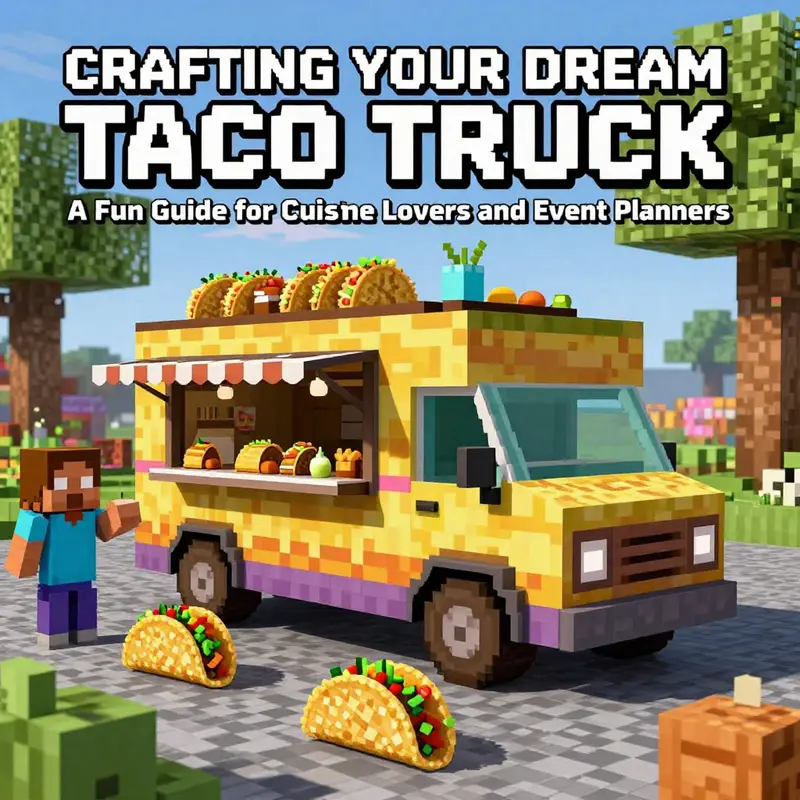
Imagine cruising through your Minecraft world, serving up delicious tacos from your very own taco truck! This whimsical venture is perfect for cuisine lovers, taco fans, local workers, event planners, and anyone who adores the vibrant culture of street food. In this guide, we’ll take you through a fun step-by-step journey to build an enticing taco truck. You’ll explore material choices, creative designs, and even add functional elements to elevate your culinary experience in Minecraft! Let’s get building and immerse yourself in the colorful world of taco trucks!
Sizzling Pixels on Wheels: A Cohesive Build Guide for a Minecraft Taco Truck
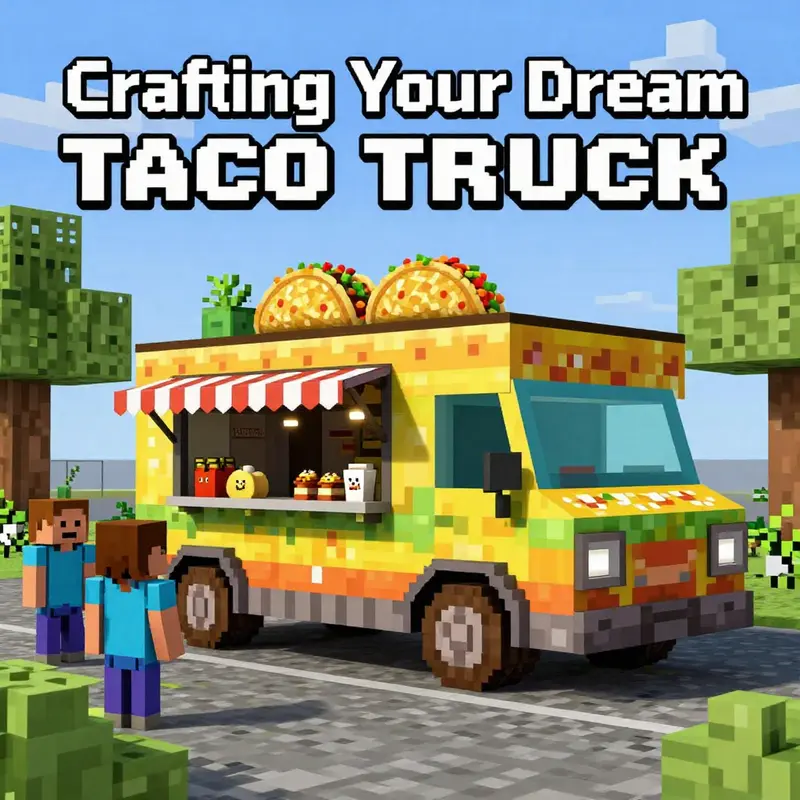
The possibility of turning a simple corner of your Minecraft world into a bustling, sunlit taco stand is a reminder that creativity can turn blocks into stories. A taco truck in a pixelated landscape is more than a decorative model; it is a micro-world that invites players to imagine neighbors strolling by, villagers stopping for a bite, and the whirr of Redstone-lit appliances signaling a thriving street-food scene. To build such a truck with care is to design a vessel that balances form and function, whimsy and practicality, color and shadow. The process unfolds like a craft narrative where every block speaks to a larger idea: a mobile eatery that travels through your biome, a beacon of warmth on a cool Nether-dust day, a shared space where players gather not just for food but for a moment of shared game-world joy. This chapter weaves a single, steady thread through the steps of construction, materials, detailing, and optional features, guiding you toward a finished taco truck that feels both authentic to the vending vibe and believably Minecraft in its texture and scale.
Begin with a sense of place, not just a shape. Location matters as much as the design. You want visibility, accessibility, and potential for interaction. A flat, open stretch near a village plaza or a well-traveled path through your base makes sense. If you’re playing on a multiplayer server with roaming villagers or travelers, a location near a central hub can become a social magnet. The surrounding terrain should read as a stage for your truck rather than a scrollable background. A few strategically placed plants, a bench, or a low fence can help establish this space without stealing the spotlight from the main attraction. The choice of seating and display is part of the theater you’re staging. People in your world should be able to imagine approaching the counter, catching a whiff of something appealing, and feeling invited to pause their journey for a while. This is the script, and your build is the stage directions.
Materials set the tone of the build. The truck’s body can lean toward a bold, contemporary vibe or a warm, rustic aesthetic, depending on your preferred mood. Concrete blocks in bright tones create a sharp, modern chassis that reads well from a distance. For a more grounded, metallic look, a darker concrete or stone-based palette provides a sense of durability and commercial character. You’ll want the body to be roughly rectangular—think in terms of a 6×4 or 6×5 footprint to give the truck a recognizable scale without overwhelming nearby structures. Glass panes or stained glass for windows let light in and allow players to peek inside the cab while preserving the clean lines that computers of the block world appreciate. A front grille can be suggested with iron bars or fences, a small nod to the vehicle’s mechanical heart. The roof, perhaps a shallow slant or a subtle rise, helps break the silhouette and gives the truck a more dynamic profile when viewed from the side.
The counter and service area anchor the build in function. Behind the front-facing display sits the stage where the culinary fantasy unfolds. A counter made with smooth stone or polished granite can feel both sturdy and approachable. A short display area—a platform or table—lets you “present” faux tacos using apples, potatoes, or other in-world substitutes that can be renamed with an anvil or in the future with resource packs. If you’re feeling adventurous and want a touch of fantasy, a small “taco counter” can be built from a combination of slabs and stair blocks to create a slightly stepped surface that reads as a real, working counter rather than a flat facade. Lighting matters, too. A few lanterns or glowstone tucked under the counter edge can help highlight the display at night, inviting late-game foot traffic to pause and imagine samples. If you’re comfortable with mods or resource packs, you can push this further with textural details that mimic sizzling grills or a rotating display, but stay mindful of how much you’re asking your game engine to render on a given world. In many builds, simplicity can be as alluring as complexity because it invites players to fill the space with their own stories.
A sign above the counter is a simple but essential flourish that gives your truck character and intent. A hand-painted sign with a name—something bold and readable—becomes the brain of your little operation. The words don’t need to be culinary poetry; a cheerful label works just fine. The sign becomes a light source of identity, allowing your truck to exist as more than a blocky vehicle. A festive awning adds color and texture as well as a practical shelter against rain or sun in the game’s weather patterns. Slabs and trapdoors can form a shade canopy, while banners or colored wool provide a colorful call to customers. The decorative strategy matters because it makes the build memorable. A few carefully chosen flourishes—a mural on the side wall, a repeating color motif, or a mascot cutout—can make your truck a landmark in your world.
Beyond the shell, consider a few mechanical touches that give the taco stand a sense of function without demanding complex Redstone solutions. A grill-like ambiance can be suggested with a furnace block or a cobbled-taste stove behind the counter. For a more playful approach, a hopper-based drop system can simulate the delivery of items in a way that feels like a tiny vending mechanism. These elements signal that you’re not just building a pretty façade; you’re building a place where players engage with the world in a momentary ritual—ordering, receiving, and moving on—before the next avatar steps forward. The trick is to imply activity without overcomplicating the design. Players will fill in the gaps with their own imagination, and that is the magic of Minecraft’s open-ended design language.
If you want your build to glow with atmosphere, lighting plays a pivotal role. Redstone lamps or glowstone at strategic points can illuminate the truck’s interior and exterior, guiding players to the service area during nighttime. A few accent lamps along the awning’s edge can create a festive vibe, reminiscent of bustling evening markets. When lighting is well judged, it’s almost a character in its own right, shaping mood and drawing eyes to the counter’s glow. The sign and the awning—when complemented by lighting—become a cohesive whole, a beacon that says, in a friendly language of color and light, “This is where a community gathers for a quick, cheerful bite.”
The build’s scale should reflect a balance between charm and practicality. You don’t want a colossal street-king of a taco truck that dwarfs your entire world, nor a miniature model that can barely contain a couple of slabs and a sign. The middle ground—a compact, street-food-inspired footprint—lets you craft the illusion of mobility while preserving room for details. A sense of depth is important too. Subtle overhangs, a small hatch on the side for imagined storage, or a tiny vent using coterminous blocks can all contribute to the perception of a working kitchen behind the counter. The eye reads a rhythm: solid base, defined cab, bright counter, vibrant signage, then decorative flourishes in the surrounding space. The rhythm is what keeps players engaged as they walk past and imagine the scene, perhaps even improvising their own recipes in the world’s language of blocks.
Incorporating NPCs or villagers as vendors can elevate the scene from a static display to a living moment. A villager standing behind the counter, grown with a sign or a simple item frame to display a taco substitute, introduces a social dimension to your truck. It becomes not only a place to admire but a place to interact with, a shared space where players can role-play a quick purchase or a friendly chat about the day’s weather in the blocky universe. If you prefer a cleaner aesthetic without villagers, you can simulate activity with subtle Redstone lanterns, a gentle sound mechanism, or a simple clickable interaction that triggers a visual or auditory cue when a player approaches the counter. The essence lies in suggesting life and commerce without overwhelming the visual clarity of the design.
Personalizing the vehicle is where your Minecraft taco truck stops feeling like a generic structure and starts feeling like yours. A mural on the side wall—perhaps a stylized taco, a sunburst in your chosen palette, or a playful motif of peppers and corn—can make the truck instantly recognizable to anyone who visits your world. A mascot, perhaps a cardboard cutout of a taco or a friendly in-world mob with a banner cloak, can grant the truck a playful identity. These touches are more than decoration; they create a narrative anchor. Players remember the truck because it has personality, not merely because it is well built. And when your friends or teammates revisit your world, they’ll look for that familiar symbol—the sign you painted, the mural you chose, the color scheme that defines the scene—and they’ll know they’ve found a place where the story continues.
If you want to push the concept toward a broader world-building project, you can view this taco-truck idea as a seed for a little neighborhood: a corner shop where players rest, swap stories, and barter items, all inside a carefully designed blocky ecosystem. You might place a couple of adjacent stalls or small awnings in the same color family, a few planters and benches, and a tiny kiosk that sells common resources like bread, apples, or comic-like decorations. The result is not just a stand but a micro-street, a breathing part of your world that confirms, block by block, that in Minecraft, even a single vehicle can anchor a scene that feels alive and shared. In that sense, the build becomes more than the sum of its parts. It becomes a memory map, a place players remember because it invites them to pause and imagine, to stroll over for a bite, and to leave a trace that others can discover and respond to as they move through the world.
For those who want a touch of community inspiration, there is value in looking at community-driven designs and tutorials. They remind builders that there is no single perfect recipe—only a set of choices that can be adjusted to taste. The design’s flexibility is the beauty of Minecraft: you can scale, recolor, or reimagine a single truck to fit a village square or a desert highway. The playful tension between blocky realism and fantasy whimsy is where the best builds live. You can preserve the truck’s essential identity while letting the surrounding environment reflect your own tastes and the mood of your world. The result is a living, breathing piece of architecture that exists not in isolation but as part of a larger, evolving landscape.
If you want a recommended path to inspiration without losing your own voice, you might explore a well-curated tutorial that emphasizes a detailed, authentic look. The guide you consult can offer practical tips on proportion, joinery, and lighting, while leaving room for your personal variations. It’s worth the effort to study how other builders translate real-world forms into the blocky, modular world of Minecraft, taking cues from color blocking, material choices, and the rhythm of the truck’s silhouette. The more you study and practice, the more confident you’ll become in translating a fun concept into a finished object that feels cohesive and alive. The taco truck is not a mere shape; it’s a learning ground for design, proportion, lighting, and narrative play.
Finally, remember that the joy of building in Minecraft is not merely in the moment of completion but in the ongoing relationship you cultivate with your world. A taco truck invites ongoing interaction—players stop, pose, share tips, exchange items, and leave little messages in signs or chiseled blocks. The truck becomes a stage on which your community can enact its own rituals: the “ordering” of a pretend taco, the “serving” of a stage-space, the “hosting” of a small world where strangers become neighbors for a moment. The build supports those rituals through careful choices: durable materials that read well at a distance, a clear service line that invites engagement, lighting that guides but does not overwhelm, and decorative touches that convey a sense of celebration. The result is not simply an object but a social artifact—a shared space that keeps giving, block by block, in a world that thrives on imagination.
If you’re curious about further ideas or want to compare approaches, there’s a stream of community content that echoes this project’s ambition. For example, a popular guide to taco truck designs highlights how a mobile storefront can feel both practical and playful, offering design tips that echo across builds. The relationship between a sturdy chassis and a inviting counter, between a bright color palette and a readable sign, recurs across many successful designs, and studying these can help you refine your own truck to suit your world’s tone and needs. Remember, the most enduring builds are those that balance clarity with creativity, utility with whimsy, and accessibility with a dash of spectacle. Your Minecraft taco truck should be a place where both the eyes and the imagination are fed—where a patient, thoughtful approach yields a scene that remains inviting, legible, and alive as long as you keep returning to it with fresh ideas and friendly intent.
For readers seeking a quick, practical touchstone, you can consult a well-regarded community model that outlines the full, step-by-step construction concept in one place, including base frame, cab, counter, and final touches. This model emphasizes how these elements come together to form a cohesive structure that reads well in both wide perspective and close inspection. While the exact materials and window choices can shift with taste and available resources, the overarching rhythm of the build remains consistent: establish the frame, shape the cab, craft the service area, add markers of identity, and then layer in atmosphere through color, light, and small, telling details. In the end, you’ll have a taco truck that doesn’t simply occupy space but activates it, inviting passersby to linger a moment and imagine their own mini-narratives in your Minecraft world.
A final thought about the craft: treat your build as a living project. Tweak the palette, swap a few blocks for texture variety, adjust the height of the awning, or add an additional decorative shelf behind the counter. Each modification tests your eye for proportion and your sense of how light and color behave in your particular world. The best builds reward experimentation, and a taco truck is exactly the kind of project that rewards a playful, iterative approach. As you refine, you’ll grow more confident not only in your technical execution but in your ability to tell a story through space, color, and texture. The result is a distinctive, welcoming food-themed landmark in your Minecraft landscape—a place where creativity, community, and curiosity converge on a simple street corner built from light, shadow, and courage with color.
Internal link for further inspiration and a broader sense of culinary-themed builds in the Minecraft universe can be found here: taco-trucks-unleashed-top-5-models-for-culinary-success.
And for those who want to see this concept in a broader, reference-rich context, you can consult an external resource that maps the broader world of taco-themed builds and player-driven machine-like kitchens within Minecraft: the Taco Truck page on the Minecraft Wiki. This page offers gallery-backed ideas and terminology that can help you think about details like signage, counter depth, and the function of a grill or stove, all in a block-based language. For a broader look at fan-made taco-truck ideas, see this external resource: https://minecraft.fandom.com/wiki/Taco_truck
Choosing Materials and Designing the Taco Truck in Minecraft
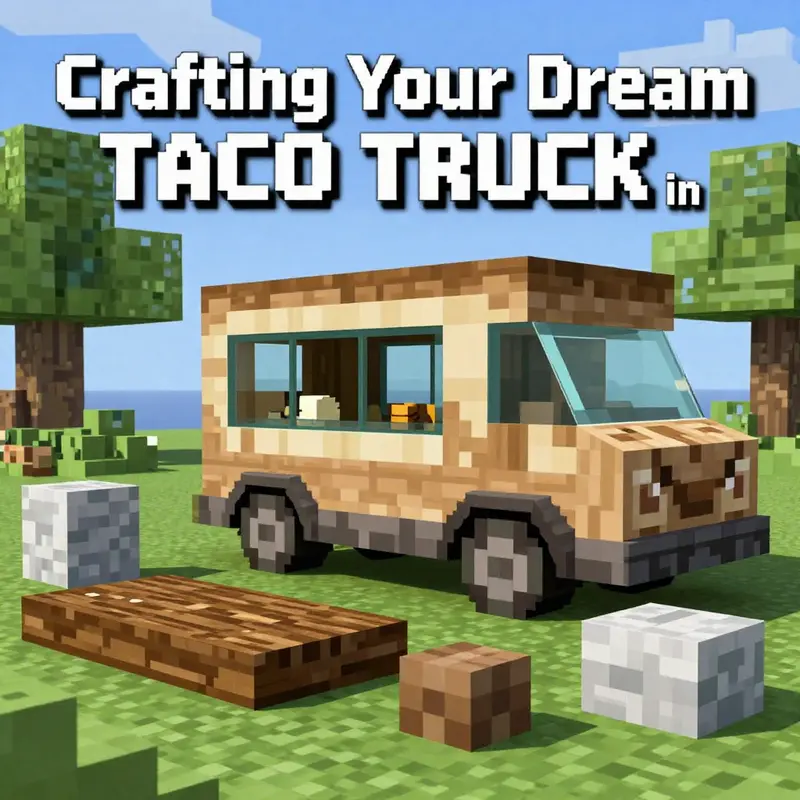
Designing a taco truck in Minecraft is less about copying a real world vehicle and more about translating the energy of street food into three dimensional space. The goal is to create something that feels solid, inviting, and a little playful, so players instantly recognize it as a place where warmth and flavor meet blocks and imagination. The process begins with a careful choice of materials, because the materials you select guide every later decision, from the silhouette of the truck to the texture of the counter and the glow of festive lighting. A well chosen palette can evoke nostalgia for late afternoon taco stands while still feeling at home in a pixelated world, and a thoughtful layout ensures the serving experience is intuitive, even for guests who have never visited a real food truck.
A sturdy base anchors the entire build. In Minecraft terms, the base is not just a foundation but a statement of durability and scale. A rectangular footprint around four by six blocks provides a compact yet workable chassis that resembles the classic compact trucks used in urban street scenes. The sensation of sturdiness can be reinforced with a frame of darker blocks that suggest a robust metal chassis or a compact utilitarian cab. Wood plays a crucial role here not as a mere aesthetic choice but as a storytelling device. Spruce or dark oak planks carry a warm, rustic vibe that echoes the idea of a hand crafted, neighborhood favorite, a truck that came to life through careful, patient work rather than mass production. This choice also keeps the build accessible to players who enjoy a more traditional, homespun look, while still allowing bold, vivid accents to pop against the wood’s natural grain.
Beyond the base, the body of the taco truck becomes a canvas for color and character. Concrete blocks in bright yellows, oranges, and reds are prime options for the exterior. Their saturated tones capture the eye much like real life taco trucks advertise their wares with loud paint jobs, polychrome banners, and bold lettering. The concrete’s clean lines contrast nicely with the warmth of wood, creating a rhythm where the truck feels both lively and anchored. The color palette is not merely cosmetic; it informs how players perceive space and movement around the truck. A yellow body with red accents can feel sunny and approachable, inviting customers to step close and peek at the sizzling counter. If you want a more nostalgia tinged look, a combination of orange and tan walls with dark trim can evoke a retro street food cart while still reading clearly in a Minecraft environment.
Details and accents are where the design truly comes to life. The awning over the serving window becomes more than a shade; it is a shelter and a sign of hospitality. Glass panes or stained glass provide a translucent canopy that glints in the sun and hints at the shelter customers expect when lining up for a quick bite. The signage, mounted above or beside the window, is essential for personality, branding, and legibility. A simple sign crafted from a couple of wooden blocks and a banner can convey a playful name while leaving room for easy updates in the future. Branding in Minecraft is as much about color language as it is about typography, so use consistent hues across banners, harness edges, and even the window frames to unify the whole display.
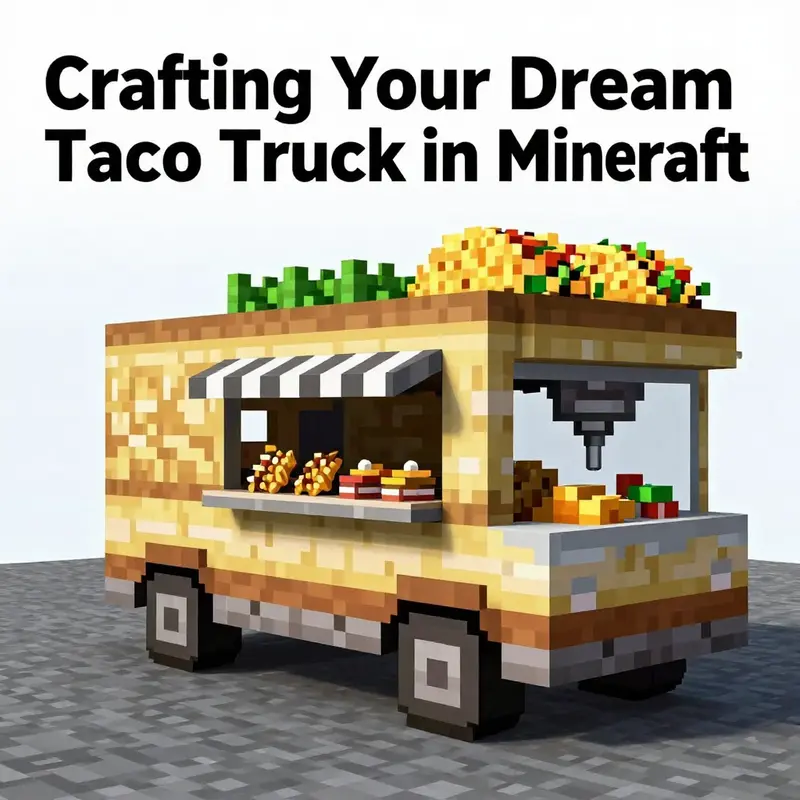
This is the moment to consider counter design. The serving counter should ground the experience in realism. A small ledge or platform built from smooth stone or polished granite gives the counter a modern, clean look that contrasts with the more rustic base and body materials. The counter doesn’t just serve as a stage for display; it invites interaction. If you want the display to look dynamic, add a few subtle details such as a row of tiny blocks to simulate chafing dishes, or place baked potatoes as a stand‑in for tacos, acknowledging the limitations of vanilla Minecraft while still suggesting the idea of a ready to serve food line. The choice of flooring inside the truck matters too. A carpeted floor in a coordinating color can soften the interior, while a wood plank floor can pull the space back toward the truck’s exterior narrative. Slabs or half slabs can be used to create a sense of stepping and tiered surfaces, which enhances the perception of depth in a compact interior.
The cooking station is where the fantasy meets function. A simple arrangement near the back or side of the truck can convey the impression of a working kitchen without overwhelming the space. A furnace or a campfire can serve as a stand in for a grill or stove, emitting light and a tiny glow that reinforces the idea of sizzling food, especially at night or in darker biomes. For players who want a touch more realism, a hopper system or a small redstone mechanism can simulate the movement of ingredients and finished dishes, though this is optional and should be approached with restraint to keep the build accessible. The idea is not to overcomplicate but to hint at activity, to suggest that something is being cooked, plated, and handed over to customers who are ready to enjoy a virtual bite.
Aesthetics guide the eye toward the heart of the truck: the interaction zone where customers approach, view, and select. Banners and colored wool can be used for a festive, world-building vibe that makes the truck feel part of a carnival of street foods rather than a purely utilitarian vehicle. A simple mural painted with wool or carpet on the exterior wall can introduce a mascot or a taste of the region your taco truck represents. The mural does not need to be elaborate; a stylized taco or a bold watermark of peppers and lemons can remind players why they stopped in the first place. The space above the counter is perfect for a light source, a glowstone replacement for modern aesthetics, or simply a line of lanterns that cast a warm, welcoming glow during evening explorations. Lighting matters not only for mood but for practicality, guiding customers toward a friendly, visible counter even on the long Minecraft nights.
The embodied truck has to feel scalable and navigable. Consider the proportions of the vehicle and how players might move around it. A four by six base ensures the truck feels compact enough to fit on a typical path or campsite yet large enough to host the counter, the cooking area, and a decorative back area without feeling cramped. The roof structure is an opportunity to add personality while also serving as a practical shield against rain in the game’s weather systems. A small overhang or a shallow angled roof can be achieved with slabs and stairs to create a sense of shelter without sacrificing interior height. A skylight made from glass blocks or light blue panes can invite sunlight into the interior, making the space feel bigger and more inviting while also providing a playful nod to modern, urban taco trucks that emphasize openness and fans of the craft.
As the design grows, it is tempting to chase the perfect chrome‑edge finish or the most elaborate redstone contraption. Yet the most memorable builds strike a balance between whimsy and legibility. The truck must read at a glance as a place to grab a bite and share a moment with friends, not just a sculpture to admire from afar. Think about the rhythm of the build in three passes: the exterior silhouette, the interior flow of form and function, and the decorative storytelling that threads through all surfaces. The shell should feel cohesive; the interior layout should feel intuitive; and the small touches—the mural, the signs, the awning—should feel earned rather than added as afterthoughts.
If you want to borrow ideas from the broader Minecraft building culture, look for layouts that emphasize a strong front counter, a clearly defined serving area, and a visible cooking station. The real charm of a taco truck lies not merely in the color or the shape but in the narrative you weave into the design—the choice of materials, the textures, and how those elements tell the story of a friendly, flavorful stop on the go. The aesthetic is a language for your world, and choosing materials becomes the grammar by which you express that language. The wooden chassis, the bold concrete body, the sheltering awning, the stone counter, and the warmly lit interior all work together to invite players to approach, explore, and participate in a shared moment of play and creativity.
To deepen the sense of authenticity, you can incorporate branding that hints at the local flavor your build represents. A banner with a simple emblem, a color motif that repeats across the sign and the awning, and even a small mascot cutout can give the truck a personality that players will recognize in a crowded Minecraft landscape. The branding should feel approachable and inclusive, a friendly invitation rather than a shout. You want players to imagine the smell of warm tortillas and the sound of sizzling, even if those senses live only in the imagination and in the texture of blocks. The ultimate reward is a build that feels alive, one that invites others to step into your world, place a block into the display, and pretend to be part of a bustling street scene.
When it comes to documentation and iteration, a little note taking goes a long way. Sketch a quick layout in your world’s creative space, block by block, and then step back to review it from different angles. Walk around the truck as a player would, pausing to inspect the counter line, the cooking area, and the signage from every vantage point. If something feels off—perhaps the counter is too low, or the signage reads poorly from the curb—adjust with minimal disruption. Minecraft tolerates change gracefully, and the ability to refine your design in small steps is one of its best features. The reward for your patience is a taco truck you can proudly place in your world, one that looks as good from across the street as it does from up close, and one that feels crafted with care rather than slapped together for a quick screenshot.
As you bring your design to life, consider linking your build to other parts of your Minecraft world. The truck can act as a partner to a nearby park, a busy market square, or a roadside food court that you create to host a small ensemble of vendors. The idea of a street food cluster mirrors real life, where a sense of place emerges not from a single stall but from the interplay of many vendors, each with its own personality and color scheme. The taco truck then becomes a hinge—an inviting portal that ties together the surrounding community of builds and players who wander the map with curious eyes and hungry imaginations. The result is not just a decorative object but a living fragment of your world’s culture, a place where friends can gather, share stories, and trade ideas as freely as they trade items.
If this chapter has suggested a certain approach to material choice and design flavor, the underlying aim remains constant: create a space that feels earned, approachable, and expressive. The specifics—wood versus concrete, the choice of counter material, the signage, the awning—are not merely technical details; they are the means by which you convey a mood and a story. The materials become a language that speaks to players about the warmth of community, the joy of creative play, and the satisfaction of watching a simple block world come alive with color and character. In Minecraft, as in life, a well designed taco truck is more than a vehicle or a storefront; it is a small theater where creativity is both the performance and the product. And when you stand back to admire the result, with the counter gleaming, the mural bright, and the shelter of the awning inviting the next guest, you’ll hear the quiet chorus of the world you’ve built: a world where flavor is framed in blocks and friendship is served warm by the side of the road.
For readers seeking a compact path to inspiration within the broader Minecraft food scene, the collection of top models for entrepreneurs offers a quick glance at how other builders balance function and flair. This resource can help you compare scale, layout, and color options, ensuring your taco truck fits your vision while remaining practical for your gameplay. Top food-truck models for entrepreneurs. If you want to push the envelope further, consider pairing the truck with simple redstone features or seasonal lighting to create a sense of movement or celebration. The journey from concept to in world reality can be as rewarding as the finished build, and the decisions you make about materials now will ripple through the entire project, guiding you toward a satisfying result that captures the playful spirit of street food in a blocky universe.
External resources can offer a supplementary perspective on turning a taco truck concept into a visually compelling and functionally coherent Minecraft build. For a broader sense of how official guidance translates into practice, explore the Minecraft official design discussions that illustrate how food trucks are imagined in game tutorials. These insights can help you refine your approach to space, color, and texture choices while staying grounded in the core ideas of accessibility, storytelling, and craft. For a deeper dive into the design philosophy behind Minecraft food truck concepts, see the official guide available at the following link: https://www.minecraft.net/en-us/article/minecraft-food-truck-design-step-step-tutorial
null
null
Final thoughts
Now that you’ve learned the ins and outs of building a delightful taco truck in Minecraft, it’s time to bring those vibrant designs and functional elements to life! Whether you’re creating an eating spot for your friends or planning a spectacular in-game event, your taco truck will surely bring joy and flavor to the Minecraft world. Embrace your creativity, mix and match colorful materials, and let your passion for tacos shine as you embark on this fun building adventure!

